Showing posts with label miguel hernandez. Show all posts

Thursday, 5 April 2012

The Murals of San Isidro

Over last weekend scores of artists were invited to cover the walls of houses in San Isidro, one of the poorest quarters of Orihuela (Spain), with the enthusiastic agreement of the people of the district. All the murals have a Miguel Hernández theme, to do with the man, his poems, or the times he lived through. The project was launched to mark the 70th anniversary of his death, in prison, at the age of 31.

The walls had been painted once before, in 1976, a few months after the death of the dictator General Franco, and before the end of censorship and the fascist police-state. The police had tried to prevent people reaching the town, but many managed to get in and get their work done quickly, quietly and in the dark.

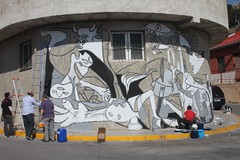
As you can see, conditions this year were very different. Work started on Friday afternoon, and had to be finished by Sunday lunchtime; these pictures were mostly taken on Saturday afternoon, with work very much still in progress.

One of the most striking pictures is a version of Picasso's 'Guernica', originally painted in 1937 to represent the horrors of modern war. It has been painted by a team of artists, on the curved wall of a house at the entrance to the district, and will hopefully serve as an emblem of the city for years to come.
NB: there are 100 photos - you can view a slideshow, or navigate through the set

Sunday, 19 December 2010

Enrique Morente

Martinete, from Enrique Morente Sueña la Alhambra

Enrique Morente, the leading flamenco singer of his generation, died earlier this week, aged 67. He is much mourned, and will be much missed, and not only in the flamenco community.

As a singer, Morente, from Granada, was capable of expressing an intensity of feeling with superb control in a wide range of traditional flamenco palos or styles. Throughout his career he was also one of flamenco's leading innovators, forever searching for ways of bringing the centuries-old forms and themes of flamenco into meaningful contact with the modern world.

These two sides of his work can be seen in some of his earliest records, produced in homage to three leading cultural figures of the early 20th century.

The work of the Republican poet Miguel Hernández was banned in Spain throughout the Franco dictatorship (1939-1975). In defiance of this censorship, in 1971 Morente became the first artist in any sphere to produce a complete work in his honour, Homenaje flamenco a Miguel Hernández, performing a set of his poems in flamenco style. 

A year later the Catalan popular singer Joan Manuel Serrat issued his own collection of songs based on Hernández poems, which gained immediate popularity in Spain; several of Serrat's songs became anthems for movements of resistance to dictatorship across the Spanish-speaking world. He has issued a further set of songs for the Hernández centenary this year, and has given scores of sell-out concerts throughout Spain and Latin America. Serrat's older songs are immediately recognised, and sung along with, by Spanish audiences, and some of the new ones probably will be, too.

Morente's songs, meanwhile, are virtually unknown. This is a great pity, because I think his versions more successfully capture the spirit and the sense of Hernández's poems in music than those of Serrat.

Morente then followed up in 1975 with Se hace camino al andar, in remembrance of Antonio Machado, generally regarded as the leading Spanish poet of the 20th century, and a major cultural figure in the Republic of the 1930s.

He was criticised by some, partly for straying from traditional flamenco themes in works like these, but also on racial grounds - he was from Andalucía, where flamenco is rooted, but he was not a gypsy. Some of the traditionalists held - some still hold - that flamenco can only be performed by gypsies.

His response was to issue a record in which he sang from the repertoire and in the style of Antonio Chacón, one of the first flamenco singers to be recorded, in Homenaje a Don Antonio Chacón (1977); Chacón was not a gypsy and was not considered authentic by some of the traditionalists - the same charge that was levelled at Morente.

It is difficult for outsiders to comment on disputes like this; it would be a family dispute, except that one side holds that the other isn't a member of the family in the first place. Many others singers and musicians have stretched the boundaries since then, but Morente continued to be regarded with suspicion by some, who probably couldn't forgive him for having started the rot.

There was a strong Granada connection to much of his work, though he sang palos from all over Andalucía. He recorded poems of Federico García Lorca, and one of his last works was the suite Morente sueña la Alhambra (2005), dedicated to the iconic fortress-palace of the Moors, which dominates the city. The stunning martinete in the video-clip above, based on the words of the Latin Good Friday hymn Omnes amici mei, is from this suite.


Morente worked with music and musicians from any and every tradition that attracted him, including African, Cuban, Algerian, and classical, and wrote a flamenco mass. The only pity is that a good deal of this material was apparently never recorded.

His most controversial project was Omega (1996), a collaboration with the Granada punk band, Lagartijo Nick, in which the flamenco sometimes gets swamped by the punk, or the punk by the flamenco, depending on where you're coming from.

The esteem he is held in can be seen in the roll-call of Spanish cultural figures who came to the chapel to pay their respects the day after he died: they included the cream of contemporary flamenco, such as Paco de Lucía, Tomatito, Miguel Poveda and José Mercé; popular singers Miguel Ríos and Alejandro Sanz; singer-songwriters Paco Ibáñez and Joaquín Sabina; film directors Carlos Saura and Pedro Almodóvar; and from the political world former prime minister Felipe González, amongst others.

Morente's daughter Estrella is now one of the leading figures amongst the younger generation of flamenco singers. Spanish television broadcast this clip of the song she sang to his coffin:


We saw Estrella in London a couple of years back, and she finished her concert with the martinete at the top of this post, with the singers in the same tight circular arrangement. Spine-tingling. She'll be back over in a couple of months - I hope she does it again, in honour of her father.

PS: I've no idea what the horse is doing there . . .

Friday, 17 December 2010

Miguel Hernández Centenary: photos

Falla Experimental - 001

A Collection of photos from my visit to Orihuela for the Centenary celebrations for the poet Miguel Hernández at the end of October.  

There are 11 Sets of photos, including an international conference, a week of public art, performance and participation in the park, a homage at the poet's tomb, poetry readings at the house he was born in and the one he spent his childhood in, a few from a concert by Joan Manuel Serrat, the creation of 100 metres of poetry, and the burning of the fallas at the end of the week. I will write more about some of these in later posts.
Note: in any of the Sets, you can browse the thumbnails, then select a photo to see a larger version; from there you can navigate using the right and left arrow keys, or pull down the Actions menu to View All Sizes and select a larger version. You can also choose to see a Slideshow, from the Set page or from the Actions menu; you can let the slideshow run, or pause and continue as you wish.
You can see a few other posts on the Centenary here on this blog (more to come), and my translations of some of Miguel Hernández's poems are on There are Nightingales that Sing, along with the original texts, a range of video, audio and visual material, and links to useful websites.

Saturday, 18 September 2010

There are Nightingales that Sing


I've now finished translating the Miguel Hernández poems I've been working on, and have put my efforts onto a web site: There are Nightingales that Sing. The poems are from the anthology 40 Poemas published earlier this year by my friends in the Asociación Cultural Orihuela 2010, as part of the celebrations marking the centenary of Hernández's birth.

You are welcome to browse the poems, which are all accompanied by illustrations by local artists - see my earlier post about the 40 Poemas folder. I've also put in links to online versions of the original poems in Spanish.


This is the first time I've attempted to translate poetry - or anything else, really. It came about when I was invited to give a talk a few months back about Miguel Hernández and his poetry to English-speaking residents of the area around Orihuela, who number tens of thousands. It was quite a relief when 'only' 50 turned up for the talk!

I was staggered to find when I was preparing the talk that there were no English-language versions of Hernández's poetry in print on either side of the Atlantic. I needed English translations for the talk so had no option but to do them myself.

We used about twenty of the poems in the talk, and the friends who read them out with me - Dee, Sarah, and Teresa - were a great help in straightening out some of the awkward phrasing in my original drafts. The other twenty have not yet made their bow in public, so I hope they flow OK.

There are a number of features I'd like to add to the site, including more information about Miguel Hernández himself and the times he lived through. I'm hoping to be able to put up the presentation I used for the talk, including the audio clips; we also have some audio and video recordings from the evening, including a stunning cante jondo performance of Nanas de la cebolla (Lullaby of the Onion), which I'll get up somewhere.

If you have any comments or suggestions, about the site or the translations, please let me know.
NB: I have put the translations under a Creative Commons licence - teachers and students are welcome to use them for educational purposes, but they must not be used for commercial gain.

Thursday, 4 March 2010

Miguel Hernández: 40 Poems

Fri 26 Feb
Orihuela

Margarita had warned me they had something to give me that they knew I would like. What could it be? Well it didn't take long for me to find out - and yes, it did involve Miguel Hernández, and poems - that's why I was there, after all. But it wasn't a book.

The Asociación Cultural Orihuela 2010 have published a folder consisting of a selection of 40 of Hernández's poems, each one illustrated by a local artist and accompanied by a commentary placing the poem in the context of his life and development as a poet. There is also a set of postcard-size reproductions of the illustrations.

The material for each poem is set out in a four-page A4 size spread, on card, with the poem occupying the first, and sometimes the second, page, the illustration on the third, and the commentary on the last. The artists were given free rein to respond to the poems as they wished, and have used a variety of approaches and techniques; the illustrations, like the poems, are always thought-provoking. The commentaries are clearly written, and very helpful. The younger Hernández seemed to delight in tying the Spanish language in knots, and the editors' clarifications and explanations are certainly helping me work through some of the ensuing difficulties.

The selection covers the full range of Hernández's poetry, from the early years when he was searching for a personal style, through playful love poems, heart-felt elegies, and poems written in the heat of battle, to some from the powerful and moving collection Cancionero y Romancero de Ausencias (Songs of Absence), written in prison not long before he died.

This collection is the most lovingly assembled work of literature I have ever set my hands on. It is available in bookshops in the area, for around €20, and directly from the Asociación, although I can't find it on sale on their website at the moment.

There appear to be very few opportunities to read Hernández's poems in English - I have only been able to find a couple of dual-language anthologies, and they have not been easy to get hold of. That may change this centenary year, of course, though as yet I have not heard of any new publications in the pipeline.

However, the Asociación website does have 16 of his most well-known poems in English translation, and also the illustrations from the 40 Poems folder.

Wednesday, 3 March 2010

Miguel Hernández: Orihuela celebrates his centenary

Fri 26 Feb
Orihuela

This year is the centenary of the birth of Miguel Hernández, one of the major Spanish poets of the 20th century. Despite his youth he became one of the leading cultural figures of the Spanish Republic during the Civil War (1936-39). In the aftermath of the war he was imprisoned, and died in jail in 1942, aged 31.

He was from Orihuela, a small town in SE Spain, and my friends there are involved in the Asociación Cultural Orihuela 2010, which is promoting and organising all sorts of events to mark the centenary. I went over this weekend to discuss the possibility of participating in some way (more on this later), and was amazed by the amount and variety of activity going on, and even more impressed by the sheer quality of it all.

I'll be posting here as things come up, starting with a few brief reflections on what I saw this weekend.